Art and Advocacy: 'A win for Indigenous Peoples is a win for all’
Native American Heritage Month (NAHM) has different meanings for different people. In this mid-term election year, NAHM ushers in a historic moment for Tribal Nations and Indigenous people across the U.S. What do these historic wins have to do with First Peoples Fund’s mission to honor and support Native artists and culture bearers? Just about everything.
But first, here are just a handful of some of those major wins for Indigenous representation:
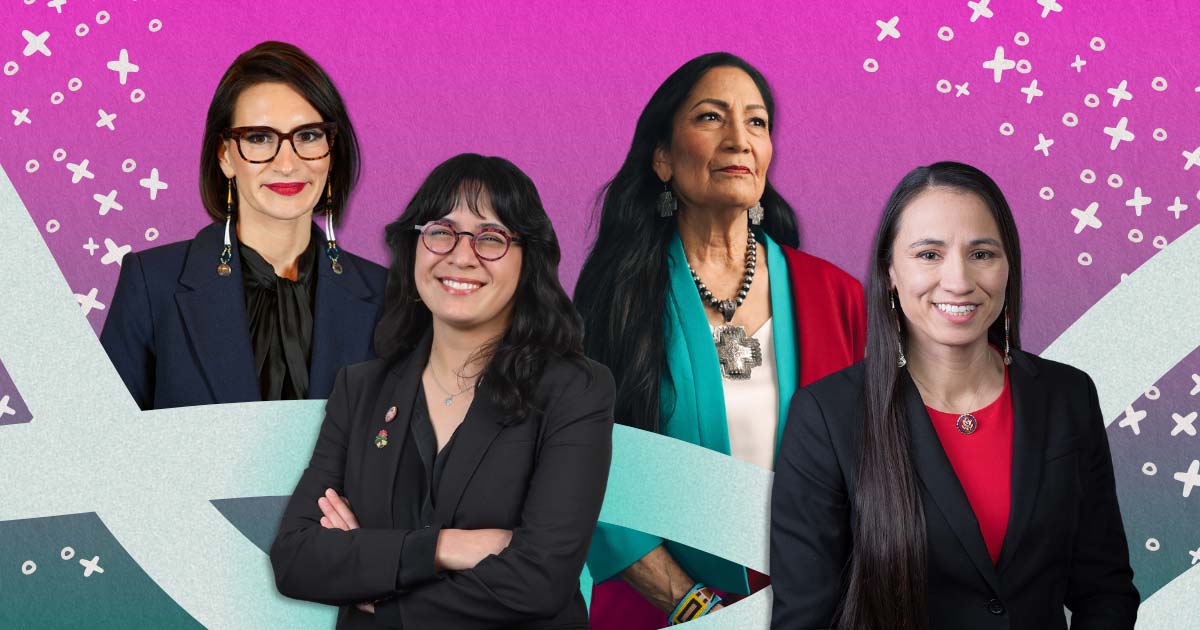
Early breaking news showed a win for Deb Haaland, Laguna Pueblo, as the first Native American woman to be elected as governor of a state. Formerly serving as one of Congress’ first Native Americans (2019-2021), Haaland will now lead the great state of New Mexico. Haaland made history earlier in her career as the first Native American cabinet secretary when she served as the Secretary of the Interior (2021-2025).
Native artists have long used their creative energy to inspire civic engagement and advocacy for our People.
All eyes were on Peggy Flanagan, White Earth Ojibwe, as she went from serving the Minnesota House of Representatives (2015-2019), to Lieutenant Governor of Minnesota (2019 to present, term ending January 2027). As the new U.S. Senator-elect from Minnesota, Flanagan is the first Native woman in the U.S. Senate.
Sharice Davids, Ho-Chunk Nation of Wisconsin, secured the 3rd District of Kansas, with a fifth-term win. Davis made history in 2018 when she became one of the first two Native American women ever elected to Congress, along with Deb Haaland, as well as the first LGBTQ+ Native American in Congress.
Claire Valdez, a citizen of the Ysleta del Sur Pueblo nation, will bring Indigenous representation to New York’s delegation as the U.S. Representative-elect for New York's 7th congressional district.
It may be a while before we have final results for Alaska Native Mary Peltola’s run for the U.S. Senate, but many of us will remain tuned into this hotly contested race. Uplifting many more wins for Indian Country, the National Congress of American Indians (NCAI) published an overview of results which they are continuing to update.
In the current, ever-changing political landscape of the U.S., the concept of "protecting democracy" has garnered a lot of attention.
With the rise of Indigenous women in key decision-making positions of power in government, we reflect back on how Native artists have long used their creative energy to inspire civic engagement and advocacy for our People.
Fashion designers, visual and performance artists, and other artist activists brought to the forefront the largely ignored issue of Missing and Murdered Indigenous Women (MMIW) and Missing and Murdered Indigenous Relatives (MMIR).
In Washington State, artist advocacy led to the enactment of House Bill 2951 in 2018 that established a statewide database, collaboration among Tribal Nations and state law enforcement, and state-allocated resources to address the issue of Missing and Murdered Indigenous Women and Girls. Artists’ advocacy made a largely invisible issue visible, bringing with it resources and collaboration that did not exist previously.
Artists have also been central to the Water Protector, LandBack, and other Indigenous movements throughout time.
In the current, ever-changing political landscape of the U.S., the concept of "protecting democracy" has garnered a lot of attention, organizing, advocacy– and resources. What is often not said is that the framework for the U.S. form of government was based largely on the governance system of the Six Nations Confederacy of the Haudenosaunee. The so-called “Founding Fathers” of the U.S. government likely would not even have been aware of this Indigenous form of democracy had they not engaged in treaty-making with the Six Nations and other Tribal Nations across the country. There were no similar models in Europe, which was dominated by monarchies.
Without our arts, our unique cultures and languages, what is there to fight for?
It is always worth noting that Great Britain, Spain, and France also engaged in treaty-making with our Tribal Nations. Treaties between U.S. Tribal Nations and the federal government, as referenced in the Commerce Clause of the Constitution, are considered the Supreme Law of the Land. Treaties are as relevant today as they were when our Ancestors signed them, often under duress, and always considering the impact on the next seven generations.
Despite the fact that the democratic republic of the U.S. was influenced by Indigenous forms of governance, tribal people today recognize that the U.S. system was not designed for us. In fact, we have managed to survive and thrive despite centuries of federal Indian policy that was specifically designed to eradicate us and our cultures.
I was once asked why I wasn’t “using” my law degree, as I focused the majority of my career on Indigenous arts and cultures. For me, the answer was simple: I got an education to serve our People. I got a law degree specifically to fight for justice for our People.
Community Spirit Award honoree Gerald (Bruce) Subiyay Miller of Skokomish used to say that “artists are our first historians.” He said that we can look to the art of ancient people to understand their culture. My perspective is, without our arts, our unique cultures and languages, what is there to fight for?
Artists and culture bearers are integral to our identities as Indigenous Peoples. We care deeply about the land and water, and our arts and cultures reflect that. Within this context, a win for Indigenous Peoples in the political arena is a win for all– for our Ancestors, for our people today, for the land and water, and all future generations.
________________________
Enjoy this post? Consider giving to First Peoples Fund to support our work. Donate here.